To choose a uniform supplier in the UAE, judge them on what they can show you, not what they promise: a physical sample in your chosen fabric, branding done in-house, a clear sizing process and a written record of your approved designs for reorders. Ask every shortlisted supplier the same questions about samples, quantities, timelines and after-sales support, and compare the answers side by side before you look at price.
Uniforms are a repeat purchase. The supplier you pick for the first order is usually the one you will rely on for new joiners, replacements and refreshes for years, so the cost of a poor choice shows up long after the first delivery. This guide sets out what to check, the questions to ask, and the warning signs that tell you to keep looking.
Start with your own brief
Suppliers can only quote accurately against a clear brief, and comparing quotes is impossible if each one is based on different assumptions. Before you contact anyone, write down:
- The roles you need to outfit and roughly how many people are in each
- The garments each role needs, for example shirts, trousers, tunics, aprons or coveralls
- Where staff work: air-conditioned offices, kitchens, outdoor posts or site work
- Your logo file, brand colours and any guidelines
- Where deliveries need to go, by emirate and by site
- The date you need uniforms in use, not just delivered
A short brief like this lets every supplier quote on the same basis. If you do not have every detail yet, a good supplier will help you fill the gaps rather than guess.
What to check before you shortlist
Can you see and touch the product?
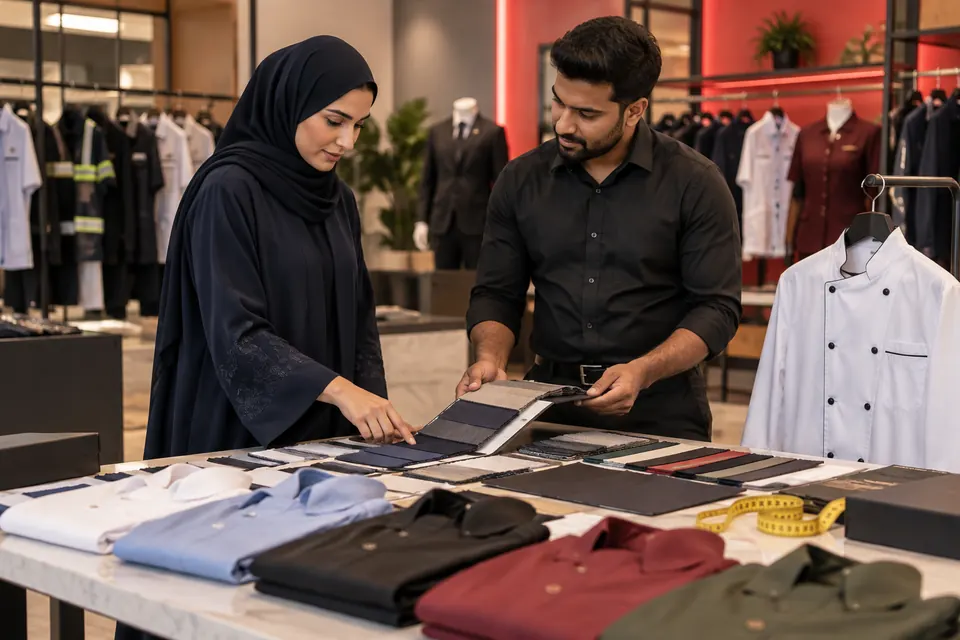
Photos and catalogues do not tell you how a fabric feels after a twelve-hour shift in summer. Ask to handle fabric swatches, try sample garments and see embroidery or printing on real fabric. A supplier with a showroom you can visit makes this easy. If a supplier cannot show you physical samples before you commit, treat that as a risk.
Is a pre-production sample part of the process?
The single most useful protection in a uniform order is an approved sample. You should see a finished garment, in your fabric and colour with your logo applied, and sign it off before bulk production starts. Ask how samples work, whether they count towards the order, and whether production waits for your written approval.
Is branding done in-house?
Embroidery and printing are where many uniform orders go wrong: thread colours that drift from your brand, logos that are too large or crooked, or names misspelled. Suppliers who brand garments in their own workshop control quality and timing directly, and can fix problems quickly. Ask where branding happens and whether you can see a stitched or printed sample of your logo.
How do they handle sizing?
Sizing errors are the most common cause of returns and delays. Ask whether the supplier can measure staff at your premises, provide size sets for staff to try, or work from your own size list. Check that sizes are recorded against each employee's name, so orders can be packed per person and reorders do not start from scratch.
What happens when you reorder?
This is the question most buyers forget. Ask whether your approved designs, fabric references, thread colours and logo files are kept on record, and what happens if a fabric is discontinued. A supplier who keeps proper records can match a reorder made a year later; one who does not may deliver garments that look slightly different from the rest of your team.
Questions to ask every shortlisted supplier
Put the same questions to each supplier in writing and compare the answers:
- Can we see and handle fabric samples before ordering?
- Will we approve a pre-production sample, and does production wait for our sign-off?
- Is embroidery and printing done in your own workshop?
- Can you measure our staff on site, and how are sizes recorded?
- What is the minimum order for each item, and how does pricing change with quantity?
- What production time do you commit to in writing for our quantities?
- How do you pack orders: by site, department or individual employee?
- Do you keep our designs and logo files on record for reorders?
- How do you handle manufacturing defects and size exchanges?
- Who is our single point of contact during the project and afterwards?
Minimum quantities and production times vary with the garment, the fabric and the season, so treat any figure as specific to your order. What matters is that the supplier states them clearly in the quotation and stands by them.
Comparing suppliers side by side
Price per piece is only one line in the comparison. A slightly cheaper uniform that fades, shrinks or arrives in the wrong sizes costs more once you count replacements and staff time. Use a simple scorecard:
| What to compare | Why it matters | Good sign |
|---|---|---|
| Physical samples | Fabric feel and colour cannot be judged from photos | Swatches and sample garments available to handle |
| Pre-production sample | Protects you from surprises in bulk | Production starts only after written approval |
| In-house branding | Controls logo quality and timing | Stitched or printed logo sample before production |
| Sizing process | Prevents returns and delays | On-site measuring and sizes recorded per employee |
| Records for reorders | Keeps new pieces matching old ones | Designs, fabrics and logo files kept on file |
| Delivery and packing | Saves time at distribution | Packed by site, department or person |
| After-sales | New joiners and defects are inevitable | Named contact and clear defect policy |
Why a local supplier helps in Ras Al Khaimah
If your business is in Ras Al Khaimah or the northern emirates, working with a supplier you can drive to removes a lot of friction. Fabric choices, size trials and sample approvals happen across a table instead of over days of email. Alterations and name embroidery for new joiners can be dropped off and collected. When a question comes up during production, someone who can answer it is nearby.
That does not mean you have to buy locally, but it is worth asking any supplier how they will handle sample approval and fittings if you cannot visit them. You can read more about working with a uniform supplier in Ras Al Khaimah, including what clients typically do at the showroom.
Warning signs to watch for
- No physical samples, only catalogue images
- Reluctance to put production times or minimum quantities in writing
- Branding outsourced to an unnamed third party
- No process for measuring or recording sizes
- Vague answers about matching reorders
- A quote that does not list fabric composition for each garment
None of these is automatically a deal-breaker, but each one is a question that deserves a clear answer before you sign.
Planning the first order
Once you have chosen a supplier, agree the project steps in writing: consultation, design and fabric selection, sample approval, measurements, production and branding, then delivery. Build in time for department heads to review samples, and plan measurements so that staff on different shifts are not missed. If you need help with fitted garments or design, our design and tailoring service covers sketches, sampling, made-to-measure work and alterations. You can also browse uniforms by sector to see the ranges we make.
Quick answers
What is the most important thing to check in a uniform supplier?
Whether they will make a pre-production sample in your fabric, colour and branding and wait for your written approval before bulk production. It is the best protection against surprises.
Should I choose the cheapest uniform quote?
Compare like for like first. Check fabric composition, branding method, sizing support and reorder records. A lower price per piece can cost more if garments fade, shrink or arrive in the wrong sizes.
How many suppliers should I compare?
Three is usually enough to see a fair range of approaches and prices without slowing the project down. Send each one the same written brief.
Do I need to visit the supplier in person?
It is not essential, but seeing fabrics, trying sizes and approving the sample in person makes decisions faster and reduces mistakes. If you cannot visit, ask the supplier to bring samples to your premises.
Ready to compare? Send us your brief and logo through our contact page, or visit our showroom on Al Manama – Ras Al Khaimah Road to handle fabrics, try sizes and talk to the team who will make your uniforms.