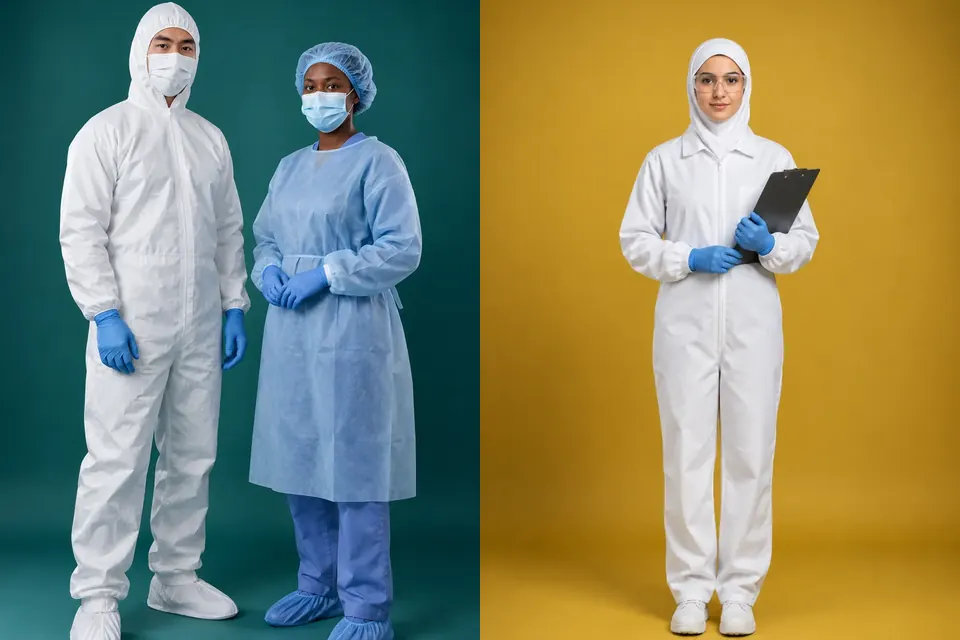
A disposable coverall is a single-use non-woven suit that keeps dust, dirt, light splashes or contamination off the wearer, or keeps the wearer from contaminating a product. For airborne dust and fibres, buyers look for Type 5; for light splashes and fine mist, Type 6; many general-purpose disposable coveralls are labelled Type 5 and 6 together. Jets of liquid, pressurised spray and gases need higher protection types, chosen with your safety officer, not from a catalogue picture.
This guide explains the protection types printed on disposable coveralls, the three materials you will be offered, when single-use beats reusable, and how to work out quantities for a crew. It is written for UAE contractors, food plants, laboratories, clinics and facility teams. To see what we supply, visit our page on disposable coveralls and non-woven PPE.
What is a disposable coverall used for?
Disposable coveralls are worn over normal clothes or a uniform and thrown away after the task, the shift or a set number of uses. Their job is either to protect the person from something dirty or hazardous, or to protect a clean area from the person. Common uses on UAE sites include:
- Painting, sanding and insulation work, where dust and overspray ruin reusable clothing
- Food and beverage plants, where hygiene rules require a clean outer layer at each entry
- Laboratories and clinics, alongside caps, masks, gloves and shoe covers
- Tank, duct and drain cleaning, where clothing cannot be laundered safely afterwards
- Visitor and inspection areas, where guests need a quick clean layer over their own clothes
What do Type 5 and Type 6 mean on a disposable coverall?
Chemical protective clothing is graded into numbered types, from Type 1, the most protective, to Type 6, the most limited. The system is set out in standards such as ISO 16602 on chemical protective clothing, and each type has its own test standard. A coverall can carry more than one type when it passes more than one test, which is why you so often see Type 5/6 on the label.
| Type | Protects against | Test standard |
|---|---|---|
| Types 1 and 2 | Gases and vapours: gas-tight or ventilated suits for specialist hazardous work | Specialist suit standards; not a general disposable coverall |
| Type 3 | Liquid-tight: pressurised jets of liquid chemicals | EN 14605 |
| Type 4 | Spray-tight: saturated liquid spray | EN 14605 |
| Type 5 | Airborne solid particles such as dust and fibres | ISO 13982-1 (EN ISO 13982-1) |
| Type 6 | Limited protection: light splashes and fine mist of liquid chemicals | EN 13034 |
Types 3 and 4 are tested under EN 14605 for liquid-tight and spray-tight clothing, Type 5 under ISO 13982-1 for airborne solid particles and Type 6 under EN 13034 for limited liquid protection. Two further marks often appear beside the type. EN 14126 for protection against infective agents adds a -B to the type, so Type 6-B means a Type 6 suit that also passed the infective-agent tests. EN 1149-5 covers antistatic properties, which matter where static could ignite dust or vapour. These European standards are listed for use under the EU regulation on personal protective equipment, in the EU list of harmonised PPE standards.
In the European Union, clothing against substances hazardous to health and against harmful biological agents falls in Category III, the highest-risk group of Regulation (EU) 2016/425 on personal protective equipment. In the UAE, the protection type you need is set by your risk assessment, your sector regulator or your client's HSE plan. Tell us the type and standard at enquiry stage: we confirm which products meet it before we quote, and you should ask for the manufacturer's declaration and test documents for that standard. We hold no certifications ourselves and never print a type on a garment that has not been tested for it.
SMS, microporous or polypropylene: which material should you choose?
Three non-woven materials cover most disposable coveralls. They differ in barrier, breathability and weight, measured in grams per square metre (GSM). Heavier fabrics last longer and block more; lighter ones are cooler and cheaper. Choosing the lightest material that passes the type you need keeps crews more comfortable in UAE heat. Each option is explained in the table.
| Material | What it is | Comfort | Barrier | Typical use |
|---|---|---|---|---|
| Spunbond polypropylene (PP) | A single layer of bonded polypropylene fibres | Very light and breathable | Low: keeps off dirt and dry dust, not liquids | Visitors, food hygiene, light dirty work |
| SMS | Spunbond-meltblown-spunbond: three layers, the middle one a fine meltblown barrier | Breathable | Better against fine particles and light splashes | Laboratories, clinics, painting preparation |
| Microporous film laminate | Polypropylene non-woven bonded to a film with tiny pores that let vapour out but keep liquid in | Warmer than SMS | Good against fine dust and light liquids; often used for Type 5/6 suits | Spraying, dusty and wet cleaning, sanitising |
Colour is mostly practical. White disposable coveralls are the most common because dirt and contamination show at once and the colour reads as clean in food and healthcare areas. Blue or other colours help separate visitors, contractors or zones. Whatever the colour, check the hood, the elastic at the face, wrists and ankles, and whether seams are stitched, bound or taped: taped seams give a better barrier than plain stitched seams.
When should you use disposable instead of reusable coveralls?
| Question | Disposable coverall | Reusable coverall |
|---|---|---|
| How dirty or hazardous is the contamination? | Best when it cannot be laundered safely or hygienically | Fine for oil, grease and everyday dirt |
| How long is the job? | Short tasks, shutdowns, visits | Daily wear, every shift |
| Is there heat, flame or sparks? | Ordinary polypropylene disposables are not flame-retardant | FR coveralls made to the standard your site names |
| Who wears it? | Visitors, inspectors, temporary workers | Your own crew, sized and named |
| What about branding? | Usually plain | Embroidered or printed logos and names |
Most sites use both: reusable coveralls for the daily crew and disposables for the dirty or controlled tasks on top. Our coverall buying guide covers the reusable side, from fabric and colour to how many each worker needs.
How should a disposable coverall fit?
Disposable coveralls are worn over clothing, so they are cut generously, and a suit that is too tight will tear at the crotch or back the first time a worker kneels or reaches up. Order one size up for workers who crouch, climb or carry, and check the length of the body and sleeves on tall workers. Elastic cuffs, ankles and hood openings, thumb loops and a zip storm flap all help the suit stay in place. Sizes usually run from S or M to 3XL or larger depending on the product, so confirm the size range in the quotation and keep extra of the two or three sizes your crew uses most.
How many disposable coveralls should you order?
Work from usage, not headcount. Count how many people enter the area, how many times each one changes per shift, and how many shifts you run. For example, a team of 40 that changes once before work and once after the break uses about 80 suits a day, or roughly 2,000 in a 25-day month, before any spare for torn suits or visitors. Add a buffer of around 10% and split the total by size.
- Count the wearers and the changes per shift for each area
- Name the protection type and standard your risk assessment requires
- Choose the material and weight, and whether you need a hood, boots or taped seams
- Give a size split and the colour
- Ask how many pieces come in each carton and how cartons are labelled by size
- Agree delivery sites and a reorder rhythm, so stock never runs out mid-shutdown
Disposables are supplied in bulk. Our usual terms apply: no minimum quantity, a minimum order value of AED 750, and production and delivery in 5 to 30 days depending on the order type and quantity. If you also make garments yourself, we supply non-woven fabric by the roll in spunbond, SMS and meltblown.
How should disposable coveralls be stored and thrown away?
- Keep cartons dry, sealed and out of direct sun, which weakens polypropylene over time
- Use the oldest stock first and keep sizes separated so supervisors can hand out the right suit quickly
- Throw a suit away when it is torn, soaked or heavily contaminated, even part-way through a task
- Dispose of used suits according to what they were exposed to: contaminated suits follow your site's waste rules, not general waste
Quick answers
What does Type 5/6 mean on a disposable coverall?
It means the suit passed both the Type 5 test for airborne dust and fibres and the Type 6 test for light splashes and fine mist. It is not suitable for jets, pressurised spray or gases.
Is SMS or microporous better?
SMS is more breathable and suits dry or lightly wet work; microporous film gives a better barrier against fine dust and light liquids but feels warmer. Match it to the type your task needs.
Are your disposable coveralls certified?
We hold no certifications of our own. Tell us the type and standard you need, and we confirm which products meet it before quoting; ask for the manufacturer's test documents for that standard.
Can disposable coveralls be used for welding or hot work?
Ordinary polypropylene disposables are not flame-retardant. For heat, flame or sparks, use reusable FR coveralls made to the standard your site names.
Do you supply white disposable coveralls in bulk?
Yes, white is the most common colour we are asked for, and other colours are available. Disposable items are supplied in bulk, packed by size in cartons.
Need disposable coveralls for a shutdown, a plant or a clinic? Send the protection type, size split and monthly usage through our bulk quote form, or ask the sales team on WhatsApp, and we will confirm availability and pricing.