For most industrial crews in the UAE, the right coverall is a one-piece poly-cotton garment in navy, blue or a hi-vis colour, with reflective tape wherever people work near vehicles, and flame-retardant (FR) fabric only where your risk assessment calls for it. Plan on at least three coveralls per worker, so one is worn, one is in the wash and one is spare, and size the crew from a measured breakdown rather than a guess.
This buyer's guide is for procurement teams, HSE officers and site managers who order coverall uniforms for factories, construction and contracting companies, oil and gas service firms, marine yards, warehouses and maintenance teams. It explains the words suppliers use, the fabrics and colours worth comparing, and what to send so the quotation is right the first time. When you are ready to see garments, our coverall uniforms for UAE crews page shows what we make in our Ras Al Khaimah workshop.
Coverall, boiler suit or overalls: what is the difference?
Buyers and suppliers use several names for the same garment, coveralls, boiler suits and overalls among them, which causes more ordering mistakes than any fabric choice. In the Gulf, a coverall is a one-piece work suit with long sleeves and full-length legs, closed with a front zip or press studs. Boiler suit is the British name for the same one-piece garment; it comes from the engineers who cleaned ship and factory boilers. Overalls can mean the one-piece suit in British usage, but in American usage it usually means bib-and-brace trousers with shoulder straps. In Arabic, buyers simply ask for افرول. When you write a tender, describe the garment rather than relying on the name.
| Term | What buyers usually mean | Typical use |
|---|---|---|
| Coverall | One-piece suit, long sleeves and legs, front zip or studs | Maintenance, oil and gas services, factories, marine |
| Boiler suit | The same one-piece garment, under its British name | Engineering, plant rooms, ships and dry docks |
| Uniform overalls | One-piece suit, or bib-and-brace trousers in American usage: confirm which | Workshops, painting, warehouses |
| Two-piece work suit | Separate work shirt and trousers in matching fabric | Drivers, supervisors, roles that need to cool down at breaks |
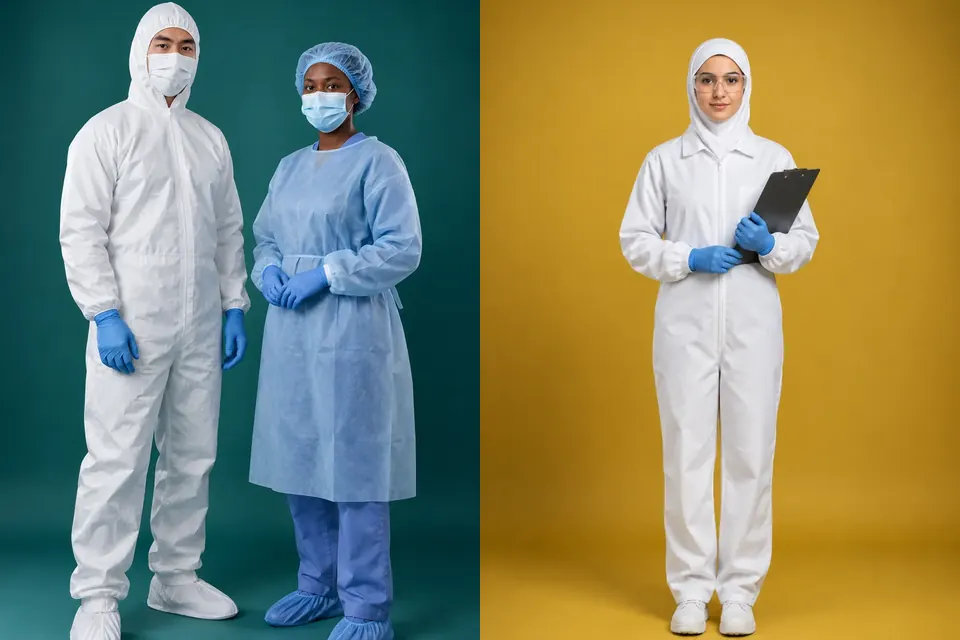
| Disposable coverall | Single-use non-woven suit, usually with a hood | Dust, paint spray, hygiene areas and short jobs |
Disposable coveralls are a different product with their own protection types; our guide to disposable coverall types covers them. The rest of this article is about reusable coveralls that are washed and worn again.
Which coverall fabric suits the job?
Fabric decides comfort, durability and safety, so choose it from the job, not from the price list: it is the biggest buying decision you make. Cotton breathes and feels cooler, poly-cotton lasts longer through industrial washing and dries faster, and FR fabrics protect against heat and flame when they are made and tested to the standard your site names. Weight matters too: a lighter fabric with reinforced stress points is often a better summer choice than a heavy twill.
| Fabric | Strengths | Watch out for | Good for |
|---|---|---|---|
| 100% cotton coverall | Breathable and soft; comfortable for long shifts in heat | Wrinkles, slower drying, fades faster than blends | Indoor maintenance, workshops, plant rooms |
| Poly-cotton | Hard-wearing, quick-drying, keeps its colour in industrial laundry | Less breathable than pure cotton; not flame-retardant | Most crews: factories, contracting, logistics |
| Flame-retardant (FR) fabric | Resists ignition and limits flame spread when made to a tested standard | Heavier and costlier; the wrong washing can reduce performance | Oil and gas, welding, hot work, electrical risk |
| Hi-vis fabric or panels | Makes the wearer easy to see near vehicles and machinery | Fluorescent colour fades with sun and washing | Ports, roads, yards and warehouses with forklifts |
Flame-retardant is not a single specification. Clothing that protects against heat and flame is tested to standards such as ISO 11612 for heat and flame, and welding clothing to ISO 11611 for welding. Your HSE team or main contractor should name the standard in writing. Send it with your enquiry and we will confirm which fabric and garment meet it before we quote; ask for the fabric's test documents for that standard, and never accept a general claim that a coverall is fireproof.
What colour coverall should each trade wear?
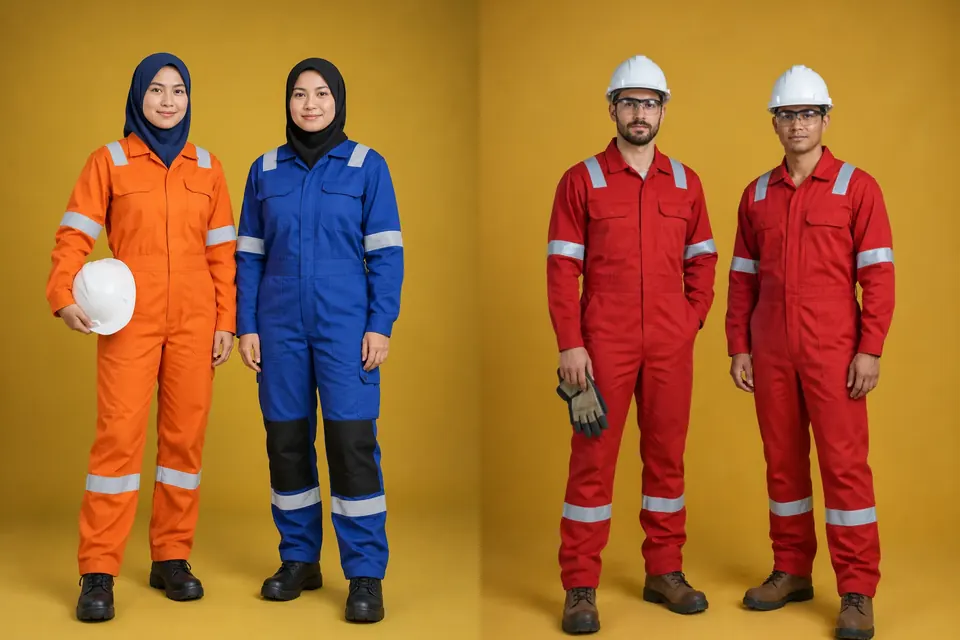
There is no single national colour code for coveralls in the UAE: companies choose colours for practical reasons, for their brand and to tell teams apart. The table below shows why certain colours are so common on UAE sites. If your client or main contractor has a colour rule, theirs comes first.
| Colour | Why companies choose it | Often seen in |
|---|---|---|
| Navy or dark blue | Hides grease and dirt, looks smart after many washes | Maintenance, factories, facility engineering |
| Royal blue | Bright brand colour that still forgives stains | Contractors, manufacturing, MEP teams |
| Orange | Stands out against sea, sand and sky | Marine, offshore support, oil and gas services, roads |
| Red | Highly visible and often a brand colour | Plant crews, emergency response teams, branded contractors |
| White | Shows contamination at a glance and reads as clean | Food plants, pharmaceuticals, painters, laboratories |
| Grey or khaki | Hides dust and fades less noticeably | Quarries, cement plants, desert sites |
Colour can also do a job on a shared site. Some companies give their own staff navy and their sub-contractors a different colour, or give supervisors and first aiders a contrasting yoke or sleeve, so anyone can see who is who from a distance.
Where should reflective tape go?
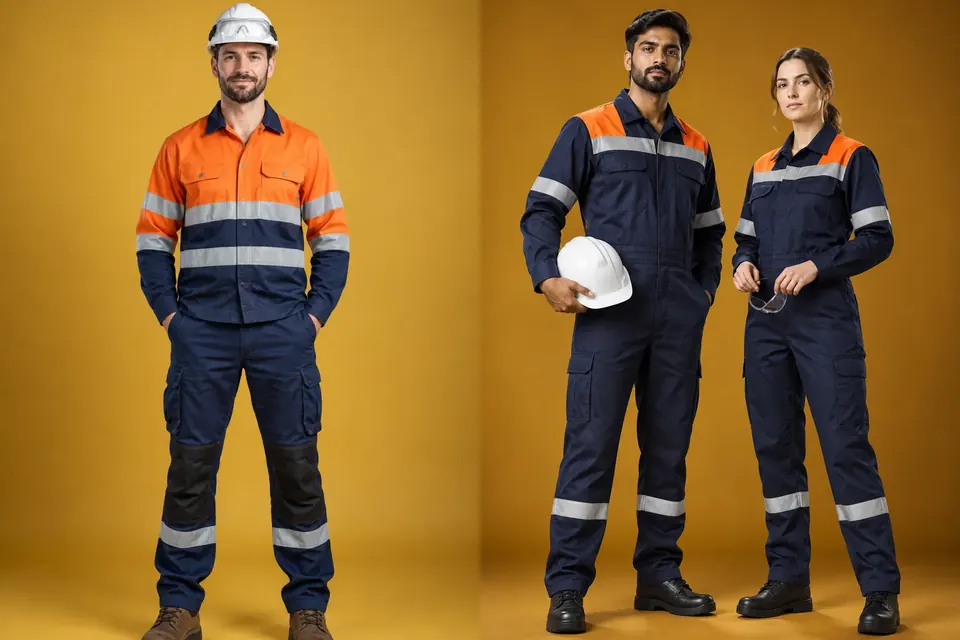
Reflective tape matters wherever people work near moving vehicles, at night or in poor light. The usual layout is a band around each arm, two bands around each leg below the knee, and a hoop around the chest and back, but the right layout depends on your site rules. If your site specifies a high-visibility standard such as ISO 20471 for high-visibility clothing, which sets requirements for colour, retroreflection and the area and placement of the materials, tell us at enquiry stage and agree the tape positions on the sample before production. Keep logos and name badges clear of the tape so they never cover it.
How do you size a whole crew?
Coverall sizing goes wrong more often than shirt sizing, because a one-piece garment must fit the chest, the waist and the length of the body at the same time. A coverall that is too short in the body pulls at the crotch and shoulders when a worker bends or climbs. We offer three ways to collect sizes, and large orders often mix them:
- We measure: we visit your site anywhere in the UAE with garment samples and take measurements, crew by crew
- You send measurements: your supervisors record them with our size chart and send one list
- Ready sizes: workers choose from letter sizes XS to 4XL using our uniform size guide
For a large crew, a try-on session with a set of sample sizes is the fastest route: each worker tries a size, the supervisor writes it next to the employee number, and the list becomes your size breakdown. Note tall and heavy-set workers separately, because a regular size that fits the chest may be short in the body.
How many coveralls does each worker need?
Three per worker is the usual starting point: one on, one in the wash and one spare. Hot, dirty or outdoor work pushes the number up, because a coverall soaked in sweat or oil needs changing every shift. Use the table as a rule of thumb and adjust it to your laundry arrangements.
| Situation | Suggested coveralls per worker |
|---|---|
| Indoor shift work, laundry at home once or twice a week | 3 |
| Daily laundry service at the camp or site | 2 to 3 |
| Outdoor or dirty work in summer, one change per shift | 4 to 5 |
| Pool for visitors, new joiners and replacements | A buffer of about 5 to 10% of headcount, spread across common sizes |
How do you care for coveralls in UAE heat?
- Wash coveralls inside out and close zips first, so the fabric and reflective tape last longer
- Follow the care label exactly for FR and hi-vis garments: bleach, softener and high heat can reduce their performance
- Dry in the shade where possible, because strong sun fades navy, red and fluorescent colours quickly
- Repair split seams and broken zips early, and retire FR coveralls with holes, burns or heavy contamination
- Replace hi-vis coveralls when the colour has faded or the tape is cracked, not when they finally tear
Our guide to washing and caring for uniforms goes deeper into laundering, and our article on workwear and hi-vis for UAE summers covers heat stress and ventilation.
What should a coverall quotation request include?
A complete request gets a complete quotation quickly. Send these details in one message:
- Headcount and size breakdown, by site or crew if deliveries are split
- Fabric: cotton, poly-cotton or FR, with the standard your site names
- Colour, plus any contrast yoke, sleeve or panel
- Closure and details: front zip or studs, pockets, knee pads, elastic waist
- Reflective tape positions, if needed
- Logo, company name and employee name positions, with your logo file
- Delivery sites and the date the coveralls must be on site
Our terms are simple: no minimum quantity, with a minimum order value of AED 750; production and delivery take 5 to 30 days depending on the order type and quantity. With full details we can send a quotation within 10 minutes. Larger programmes run through our bulk uniform supply service, with one account manager and packing by crew, site or employee.
How do you choose coverall suppliers in the UAE?
Many coverall suppliers in the UAE sell from stock; fewer make the garment, add the branding and keep your approved design on file for the next order. Ask every supplier for a sample in your fabric and colour, ask who does the embroidery, and ask how a reorder in six months will match the first batch. We cut, sew, embroider and print in our Ras Al Khaimah workshop and deliver free to all seven emirates, which helps when crews are spread from Ruwais to Fujairah. Our checklist for choosing a uniform supplier has the full list of questions.
Quick answers
Is a boiler suit the same as a coverall?
Yes. Boiler suit is the British name for a one-piece coverall with long sleeves and legs. Overalls can mean the same garment or bib-and-brace trousers, so always describe the garment in your order.
What is the best coverall fabric for UAE summers?
For most crews, a mid-weight poly-cotton or a lighter cotton with reinforced seams. Choose FR fabric only where the site requires it, and look at ventilation and fit as closely as fibre.
Do you make flame-retardant coveralls?
Yes. Tell us the protection standard your site requires and we will confirm suitable FR fabric and garment details in writing before quoting.
How many coveralls should each worker get?
Three is the usual minimum: one worn, one in the wash, one spare. Outdoor and dirty work in summer often needs four or five.
Can you add company logos and employee names?
Yes. We embroider or print logos on the chest and back and names on the chest, in our own workshop, and keep the approved layout on file for reorders.
Is there a minimum order for coveralls?
There is no minimum quantity. The minimum order value is AED 750, so a small crew can order as easily as a large one.
Ready to price coveralls for your crew? Send the headcount, sizes, fabric and logo through our bulk quote form, or message our sales team on WhatsApp. You can also visit our showroom in Ras Al Khaimah to see fabrics and sample coveralls.