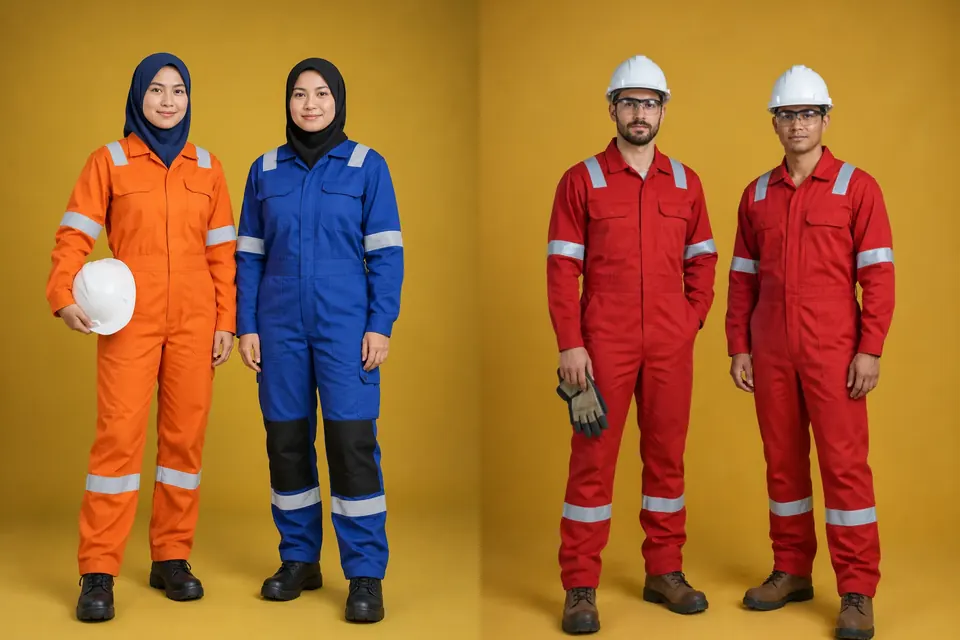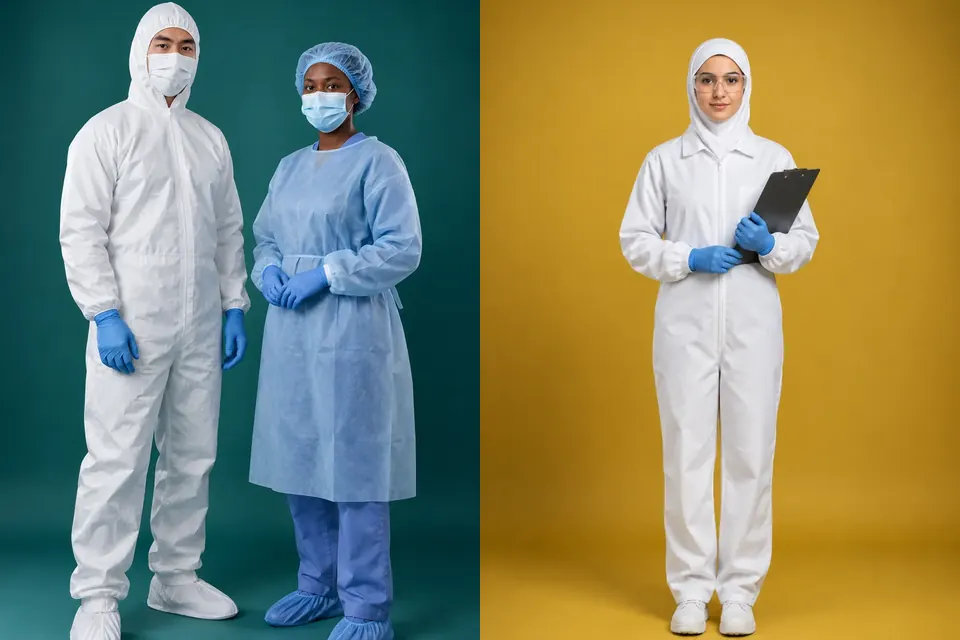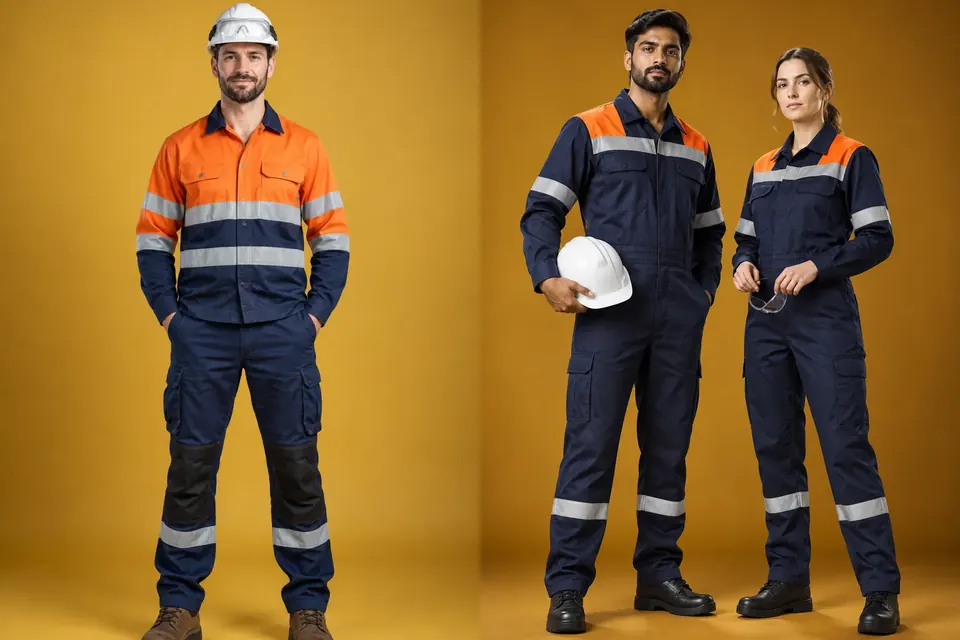
A good labour uniform for the UAE summer is a light work shirt and trousers, or a light coverall, in breathable cotton or poly-cotton at the lighter end of the usual workwear weights, in a light or mid colour, with long sleeves for sun protection and a relaxed fit that lets air move. Give each worker enough sets for a clean, dry change every day, and remember that clothing supports, but never replaces, the midday break, shade and water.
This guide is for companies that employ labour crews outdoors or in hot, unconditioned buildings: construction and contracting, landscaping, logistics yards, ports, factories and facility management. It covers the work uniform itself, garment by garment. For hi-vis and heat-stress planning in more depth, read our guide to workwear and hi-vis for UAE summers; for the garments we make, see industrial workwear and work uniforms.
What does the midday break mean for labour uniforms?
Every summer the Ministry of Human Resources and Emiratisation (MOHRE) applies a midday break that stops work under direct sunlight and in open-air areas between 12:30 and 3:00 pm. MOHRE set it from 15 June to 15 September in its 2024 announcement of the midday break, and the same dates and hours were reported for 2026, the rule's 22nd year, in Gulf News coverage of the 2026 break. Some technical work, such as pouring concrete or laying asphalt, can be exempt, and reports of the 2026 announcement note that employers are expected to provide shaded rest areas. Check MOHRE's announcement each year for the current dates, hours and exemptions.
For uniforms, the break changes two things. Workers start earlier and finish later, so they wear the same garments through a cool dawn, a hot late morning and a warm evening; and they rest in shade at midday, often sitting on the ground or on equipment, so fabrics need to dry quickly and survive rough surfaces. A uniform that suits that whole day is lighter than most buyers expect, and the number of sets matters as much as the fabric.
Which fabric weight suits a labour uniform in summer?
Fabric weight is given in grams per square metre (GSM). Heavier fabric lasts longer and protects better against abrasion, but traps heat. For most outdoor labour roles in summer, a lighter twill or drill with reinforced stitching at the stress points outperforms a heavy fabric that workers unbutton or roll up by 10 am. Our uniform fabric guide lists the typical weights for every uniform fabric.
| Garment | Summer choice | Why |
|---|---|---|
| Work shirt | Cotton or poly-cotton twill or drill at the lighter end of the usual 180 to 300 GSM range; poplin around 100 to 160 GSM for lighter duties | Breathes, dries faster, still takes embroidery and tape |
| Work trousers | Poly-cotton twill, reinforced at knees and seat | Trousers take the abrasion; weight can stay higher than the shirt |
| Coverall | Light cotton or poly-cotton with a full front zip | Easy to open at breaks; one garment to issue and wash |
| Polo or T-shirt layer | Moisture-wicking polyester knit around 120 to 180 GSM | Cool for active work under a hi-vis vest |
| FR garments | Only for roles whose risk assessment requires them | FR fabric is heavier: limit it to the tasks that need it |
Do light colours really keep workers cooler?
Light colours reflect more sunlight than dark ones, so a sand, light grey, light blue or white shirt feels cooler in direct sun than navy or black. The trade-off is dirt: light colours show grease and dust, which is why many companies choose a light shirt with darker trousers, or a mid-blue or grey coverall that sits between the two. Where workers need hi-vis, the fluorescent colour already does the reflecting, and the question becomes how light the garment underneath can be.
| Colour choice | In direct sun | Hides dirt | Good for |
|---|---|---|---|
| White or sand | Coolest | Poorly | Supervisors, inspection, clean trades |
| Light grey or light blue | Cool | Fairly well | General labour shirts |
| Mid blue or grey | Moderate | Well | Coveralls and trousers for mixed work |
| Navy or black | Hottest | Very well | Indoor or shaded work, workshops |
| Fluorescent yellow or orange | Moderate | Poorly | Roads, yards and anywhere near vehicles |
Long sleeves or short sleeves for outdoor workers?
For work in direct sun, a light long-sleeved shirt usually protects better than a short-sleeved one, because it shields the arms from sunburn and reduces how much the sun heats the skin directly. Short sleeves suit shaded or indoor work and roles near rotating machinery where loose cuffs are a hazard. A practical compromise is a long-sleeved shirt with button tabs, so workers can roll and fix the sleeves during a short task and roll them down again in the sun.
Which design details help in the heat?
- Vents under the arms or across the back yoke, covered by a flap so they do not let in dust
- A relaxed, not baggy, fit that leaves room for air to move without catching on equipment
- A full-length front zip on coveralls, so workers can open them in the shade
- Caps with a neck flap, or a hard-hat sun brim where helmets are worn
- A chest or leg pocket deep enough for a small water bottle, so drinking water stays within reach
- Embroidered rather than large printed logos on the chest, because big printed panels hold heat
How many uniform sets does each labourer need in summer?
Sweat is the real problem in summer: a shirt soaked through by the end of the morning is uncomfortable, unhygienic and wears faster. Plan sets around the laundry cycle at the accommodation rather than around the calendar. A worker whose clothes are washed every other day needs at least three sets; if the camp laundry runs twice a week, four or five is more realistic. Add a buffer of common sizes at each site for new arrivals and torn garments.
| Laundry arrangement | Sets per worker in summer |
|---|---|
| Daily laundry at the accommodation | 3 |
| Laundry every two or three days | 4 |
| Laundry twice a week or less | 5 |
| Workers wash their own clothes by hand | 4 to 5, in quick-drying fabric |
How should labour uniforms be washed in summer?
- Wash after every wear in summer; sweat and dust left in fabric weaken it and cause odour
- Use warm, not hot, water and avoid bleach on coloured garments and hi-vis
- Dry in the shade or indoors: strong UAE sun fades colours and stiffens fabrics within weeks
- Keep FR and hi-vis garments to their care labels so their protection is not reduced
- Give each worker a laundry bag marked with their name or employee number, so sets do not get mixed
Our uniform care and laundering guide has stain and storage advice that camp laundries can follow.
How do you order labour uniforms for a summer project?
Order before the heat, not during it. A crew sized and supplied in April or May starts the summer with fresh garments; a crew ordered in July spends the hottest weeks in last year's faded sets. When you request a quotation, send the number of workers by role, the work conditions, your preferred colours and logo, and the sets per worker. We can measure crews on site, work from your size list, or supply ready sizes from XS to 4XL. There is no minimum quantity (minimum order value AED 750), and production and delivery take 5 to 30 days. Large crews are packed by site or employee so supervisors can hand out sets at the gate; our guide to ordering uniforms for a large workforce walks through the steps.
Quick answers
What is the best fabric for a labour uniform in UAE summer?
A light cotton or poly-cotton twill or drill for shirts, a slightly heavier poly-cotton for trousers, and moisture-wicking polyester knit for polos under hi-vis. Use FR only where the risk assessment requires it.
When is the UAE midday break?
MOHRE applies it from 15 June to 15 September, from 12:30 to 3:00 pm, for work under direct sunlight in open areas. Check the ministry's announcement each year for dates and exemptions.
Should outdoor workers wear long sleeves in summer?
Usually yes, in a light fabric: long sleeves protect the arms from direct sun. Short sleeves suit shaded or indoor roles and work near rotating machinery.
How many work uniforms should a labourer get?
At least three sets in summer, and four or five where laundry is less frequent than every other day.
Can you embroider our logo on labour uniforms?
Yes. We embroider or print logos and names in our Ras Al Khaimah workshop and keep the approved layout for reorders, so every crew matches.
Getting crews ready for summer? Send the roles, headcount and sets per worker through our bulk quote form or message us on WhatsApp, and we will suggest fabrics and colours for your sites.