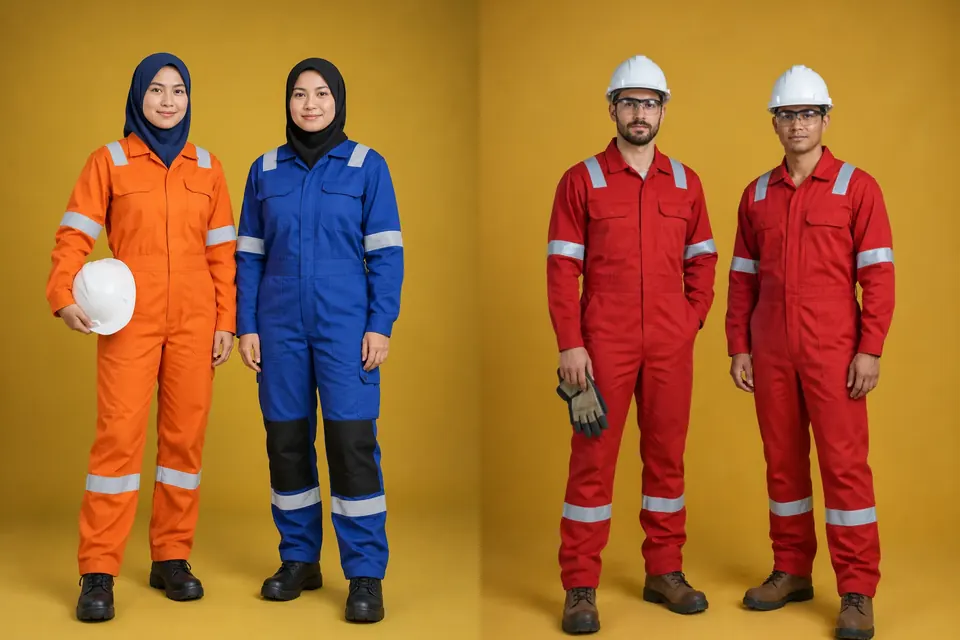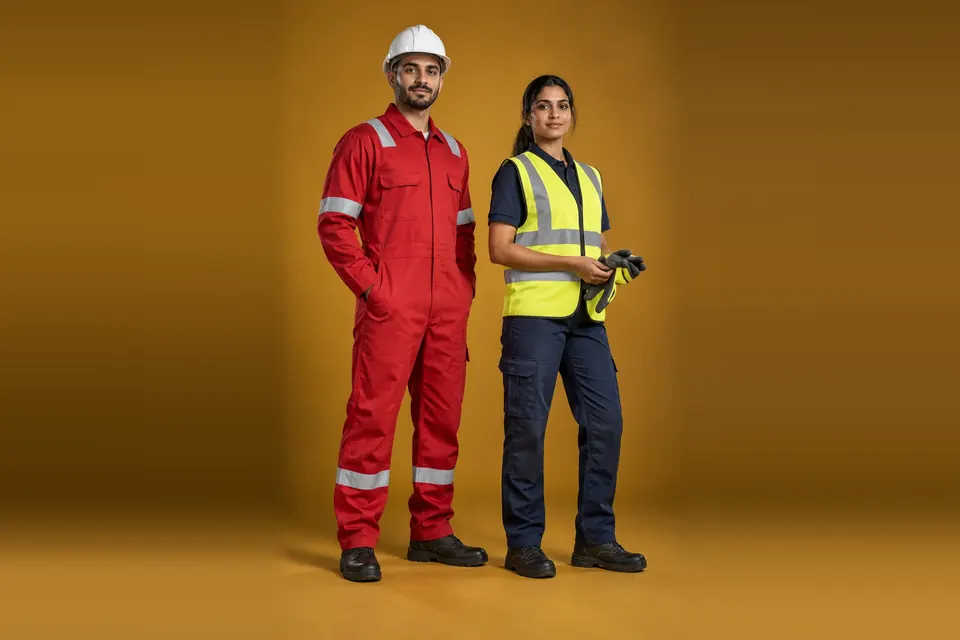
A construction site uniform in the UAE is usually a work shirt or coverall, work trousers and a hi-vis layer with reflective tape, in the company's colours and with its name on the back, worn with the helmet, boots, gloves and glasses the site's safety plan requires. The main contractor's HSE plan sets the rules on each project, so read it first, then choose the lightest garments that meet it and supply enough sets for daily changes.
This guide is for contractors, sub-contractors, MEP companies and project managers dressing site crews. It explains what site managers typically ask for, how to choose hi-vis colours and tape, how to layer for summer days and cool winter nights, and how to keep many trades and companies easy to tell apart. The garments themselves are on our industrial workwear and work uniforms page.
What do site managers usually require from a uniform?
Requirements differ from project to project, so treat this list as what site managers commonly ask for, not as a legal checklist. Your contract and the main contractor's HSE plan are the documents that count; ask for the clothing section in writing before you order, and send it to your supplier with the enquiry.
- Long trousers and, on many sites, long sleeves, for protection against sun, abrasion and splashes
- A high-visibility layer for anyone working near plant, vehicles or traffic, often at all times on site
- Company identification: the company name or logo on the back and chest, so supervisors can see who belongs to which contractor
- A distinct colour or vest for supervisors, HSE officers, first aiders and banksmen
- Garments that fit over or under the required PPE without loose ends that can catch
- Clean, intact garments: torn clothing and faded hi-vis are often picked up on site inspections
Helmets, safety boots, gloves and eye protection are part of the same site rules but are usually bought as PPE rather than as uniform; check that the garment colours you choose work with the helmet colours the site uses for each role.
Yellow or orange: which hi-vis colour should a site use?
Both fluorescent yellow and fluorescent orange are standard hi-vis colours. The choice is about contrast with the background and about site convention. Yellow stands out against most urban and desert backgrounds; orange stands out better against green landscaping and some sea and sky views, and is common in road, port and rail work. Many main contractors fix one colour for the whole project so that hi-vis means the same thing everywhere.
| Setting | Common choice | Why |
|---|---|---|
| Building sites in cities | Fluorescent yellow | Strong contrast against concrete, sand and steel |
| Road and infrastructure works | Fluorescent orange or yellow, per the project | Orange is common where traffic management uses orange equipment |
| Ports, marine and offshore support | Fluorescent orange | Contrast against water and sky |
| Landscaping and parks | Fluorescent orange | Contrast against greenery |
| Night work in any setting | Either colour, with generous reflective tape | At night the tape, not the fabric, makes the worker visible |
Where should reflective tape go on site uniforms?
Reflective tape is what makes a worker visible in vehicle headlights. The usual layout on a shirt or coverall is a band around each arm, two bands around each leg on trousers and coveralls, and a hoop around the torso, or braces over the shoulders on a vest. If the site specifies ISO 20471, the high-visibility clothing standard, the garment has to meet its requirements for colour, retroreflection and the area and placement of the materials; tell us at enquiry stage and we will confirm which garments are made to it before quoting. Agree the tape layout on the sample, keep printed and embroidered logos clear of the tape, and replace garments when the fluorescent colour fades or the tape cracks.
How should construction crews layer for UAE weather?
UAE sites swing from summer heat to cool winter nights and early mornings, and night shifts run all year on some projects. Layering lets one uniform system cover all of it, with practical layers you add or remove:
| Season or shift | Base | Middle | Outer |
|---|---|---|---|
| Summer days | Moisture-wicking hi-vis polo or T-shirt, or a light long-sleeved work shirt | None | Mesh hi-vis vest if the base is not hi-vis |
| Spring and autumn | Light long-sleeved work shirt | None | Hi-vis vest |
| Winter days | Work shirt | Sweatshirt in company colours | Hi-vis vest |
| Winter nights and early starts | Work shirt | Fleece or sweatshirt | Insulated hi-vis or work jacket with reflective tape |
Our winter work jackets cover the cooler months, and our article on labour uniforms for the UAE summer goes deeper into fabrics, colours and sets for the hottest weeks.
How do you colour-code trades and companies on a shared site?
On a large project dozens of companies share one site. Colour coding helps supervisors see who is who at a glance, but it only works if it is simple and agreed with the main contractor. Common approaches are shown below; use whichever matches the project's rules.
| Who | Common approach |
|---|---|
| Your own workforce | Company colour shirts or coveralls with the company name on the back |
| Supervisors and foremen | A contrasting shirt colour or a vest marked Supervisor |
| HSE officers and first aiders | A distinct vest or sleeve marking agreed with the main contractor |
| Sub-contractor crews | Their own company colours and names, never yours |
| Visitors | Hi-vis vests printed Visitor, kept at the gate |
What branding works on site uniforms?
- Company name printed large across the back, readable from a distance
- Logo embroidered on the left chest of shirts and coveralls
- Trade or role wording on the back or sleeve, such as Electrician, Rigger or Supervisor
- Worker names on the chest for supervisors and long-term crews
- On FR garments, a branding method that does not reduce the protection, confirmed before decoration
Embroidery lasts the life of the garment; printing suits large back names on lighter fabrics. Our comparison of embroidery and printing for logos explains the trade-offs.
How do you supply uniforms for a project mobilisation?
Construction workforces build up quickly at mobilisation and change as trades come and go. Plan the first issue for the crew on site in the first weeks, then top up as each trade arrives. Keep a small stock of common sizes in the site store for new arrivals, and ask your supplier to pack each delivery by crew or site so the storekeeper can issue it straight away. We measure crews on site, work from your size lists or supply ready sizes from XS to 4XL, deliver free to sites in every emirate, and keep the approved design on file so later deliveries match. There is no minimum quantity (minimum order value AED 750), and production and delivery take 5 to 30 days depending on the order type and quantity. For large crews, see our guide to ordering uniforms for a large workforce.
Coveralls or two-piece uniforms on site?
Coveralls protect clothing completely and are quick to issue, which suits MEP, maintenance and finishing trades. A two-piece work shirt and trousers is cooler, lets workers remove a layer at breaks and allows separate sizes for top and bottom, which suits general labour and supervisors. Many contractors use both. Our coverall buying guide compares fabrics, colours and quantities for one-piece garments.
Quick answers
Is hi-vis required on UAE construction sites?
Most main contractors require a hi-vis layer for anyone working near plant, vehicles or traffic, and many require it at all times on site. The project's HSE plan sets the rule; ask for it in writing.
Can you make hi-vis shirts in our company colours?
Yes. We combine company colours with hi-vis panels and reflective tape, and agree the layout on the sample before production.
Do you supply helmets and safety boots?
Our order covers the garments: shirts, trousers, coveralls, hi-vis, caps and jackets. Helmets and other PPE are bought to the site's own specification.
How quickly can a new project crew be supplied?
Production and delivery take 5 to 30 days, depending on the order type and quantity. Sending sizes and the logo with the enquiry keeps the time at the shorter end.
Can you deliver straight to the site?
Yes. Delivery is free to every emirate, packed by crew, site or employee so the site store can issue sets immediately.
Mobilising a new project? Send the trades, headcount, site rules and logo through our bulk quote form, or reach the sales team on WhatsApp, and we will propose a uniform and hi-vis set for each role.